
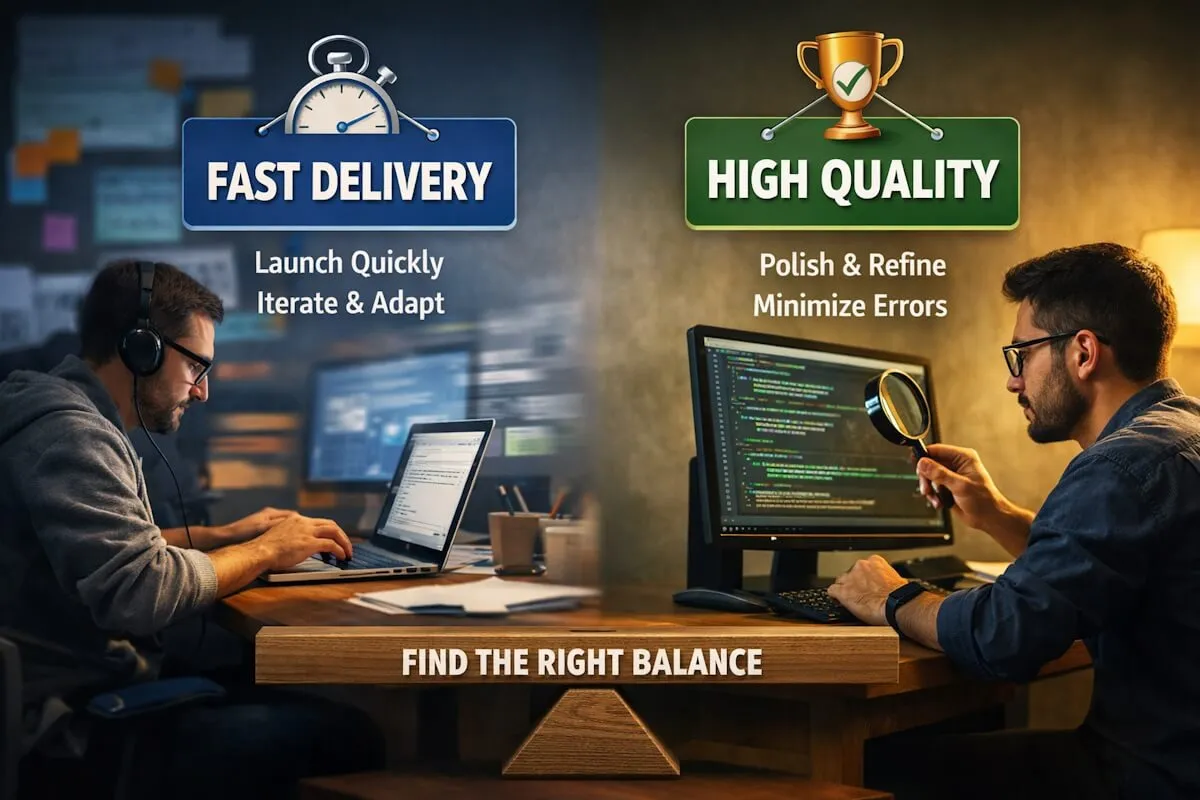
You’ve probably faced this at some point. A project is moving forward, deadlines are creeping closer, and then the big question pops up. Do you ship it fast or wait until everything feels just right?
It sounds simple, but it’s not. Teams argue over it. Stakeholders stress over it. And you, right in the middle, have to decide what actually works.
Let’s break this down in a way that actually helps you make better decisions, not just debate the idea.
Why Speed Feels So Important Today
Things move quickly. Markets shift. Customer expectations change overnight. If you wait too long, someone else might grab the opportunity before you.
Speed gives you an edge. It lets you test ideas early. It puts your product in front of real users instead of keeping it stuck in development.
Think about it. Would you rather launch something useful today or something perfect six months later that no one asked for anymore?
Fast execution helps you:
- Get feedback early
- Adjust direction without heavy losses
- Stay ahead of competitors
- Keep stakeholders engaged
Still, speed comes with its own risks. Move too fast and you might build something unstable or confusing.
So yeah, speed is powerful. But it’s not the whole story.
The Case for Perfection
Now let’s talk about the other side.
Perfection sounds ideal. Clean code. Smooth experience. No bugs. Everything just works.
And honestly, that matters. Users notice quality. A broken product can damage trust fast. One bad experience can push users away for good.
Perfection helps you:
- Build credibility
- Reduce technical issues later
- Deliver a better user experience
- Avoid constant rework
But chasing perfection can slow everything down. Teams get stuck refining small details. Decisions get delayed. Progress stalls.
At some point, perfection becomes a trap.
You keep polishing, but nothing ships.
The Real Problem Isn’t Speed or Perfection
Here’s the truth most people miss.
It’s not about choosing one over the other.
It’s about knowing when to focus on speed and when to push for quality.
Different phases of a project need different priorities.
Early stage? Speed matters more.
Growth stage? Balance both.
Mature product? Quality starts to take the lead.
If you treat every stage the same, you’ll either rush too much or overthink everything.
Where Speed Should Win
There are moments when speed is the smarter move.
If you’re building a new product or testing an idea, waiting for perfection doesn’t make sense.
You don’t even know if users want it yet.
This is where IT Consulting Services can guide you in defining what’s “good enough” for launch. Instead of overbuilding, you focus on delivering core value first.
Speed is key when:
- You’re validating an idea
- You need quick market entry
- Requirements are still changing
- You want real user feedback
The goal here is simple. Learn fast.
Not impress. Not perfect. Just learn.
Where Perfection Deserves Attention
Now flip the situation.
Let’s say your product already has users. People rely on it. They expect it to work every time.
This is not the place to cut corners.
Here, quality matters more.
You need stable systems. Clean architecture. Strong performance.
This is where teams often choose to Hire IT Consultants who can step in, audit systems, and improve code quality without slowing everything down.
Perfection, or at least a high standard of it, matters when:
- You’re scaling your product
- You’re handling sensitive data
- Downtime directly affects revenue
- User trust is critical
In these cases, rushing can cost more than waiting.
The Hidden Cost of Going Too Fast
Speed sounds great until things start breaking.
Rushed development often leads to:
- Poor code structure
- Bugs that pile up
- Frequent patches and fixes
- Frustrated users
And here’s the kicker. Fixing rushed work later usually takes more time than doing it right the first time.
So while speed helps you move forward, it can also create future problems if not managed well.
The Hidden Cost of Chasing Perfection
On the other hand, perfection has its own cost.
You delay launches. You miss market timing. Competitors move ahead.
Teams get stuck in endless cycles of revision.
And sometimes, you end up building features no one even uses.
That’s time and effort wasted.
So perfection, when taken too far, can quietly kill progress.
Finding the Balance That Works
So how do you actually balance speed and perfection?
You don’t guess. You define clear priorities.
Start by asking:
- What’s the goal of this phase?
- Who are we building for right now?
- What happens if we delay?
- What happens if we rush?
These questions help you make practical decisions instead of emotional ones.
A simple approach you can follow:
- Build a basic version first
Focus on core functionality. Skip unnecessary extras. - Launch early
Get real feedback instead of relying on assumptions. - Improve continuously
Fix issues, refine features, and upgrade performance over time.
This way, you’re not choosing between speed and perfection. You’re using both at the right time.
Why External Perspective Helps
Sometimes, teams get too close to their own work. It becomes hard to judge what’s enough and what’s too much.
That’s where outside expertise makes a difference.
With IT Consulting Services, you get a clearer view of priorities, risks, and trade-offs. You’re not guessing anymore.
And when you Hire IT Consultants, you bring in people who’ve handled similar situations before. They know when to push forward and when to slow things down.
It saves time. It avoids costly mistakes. It keeps your project moving in the right direction.
A Simple Way to Think About It
Here’s an easy way to frame it.
Speed helps you start.
Perfection helps you sustain.
You need both, just not at the same time in the same way.
Push too hard on speed, and things break.
Push too hard on perfection, and nothing moves.
The sweet spot is knowing what matters right now.
So, What Should You Choose?
If you’re expecting a one-size-fits-all answer, there isn’t one.
It depends on your project, your stage, and your goals.
But here’s a practical takeaway you can use right away.
If you’re unsure, lean slightly toward speed. Get something out. Learn from it. Then improve.
Because real feedback beats assumptions every time.
Still, don’t ignore quality completely. Even a fast release should meet a basic standard.
You don’t need perfect.
You need progress that makes sense.
Final Thoughts That Actually Matter
At the end of the day, IT projects aren’t about speed or perfection alone. They’re about delivering something that works, solves a problem, and keeps getting better.
So next time you’re stuck in this debate, pause for a second.
Ask yourself what matters right now.
Not in theory. Not in general.
For your project.
Because the right choice isn’t fixed. It shifts as your project grows.
And once you start seeing it that way, decisions become a lot easier.